

Quilting and Writing: How We Piece Together Stories
What quilting taught me about storytelling
Before the words
Whenever I am not writing, I wonder how the non-writing thing informs my writing. I wonder how EVERYTHING informs my writing. From supportive friends to amazing meals to quiet walks to travel to family to hobbies, I try to understand how they help me make sense of the world.
And I have gotten to the point in my life where, if something does not inform my writing, I wonder whether it is even worth engaging with. This usually points to things about which I feel apathetic. And as a result, my life is basically full of passions. Though, too, I wish horrifyingly toxic people did not make such amazing story characters. (Yiyun Li once told me, “The people you DON’T want in your real life are the people you DO want in your stories.”)
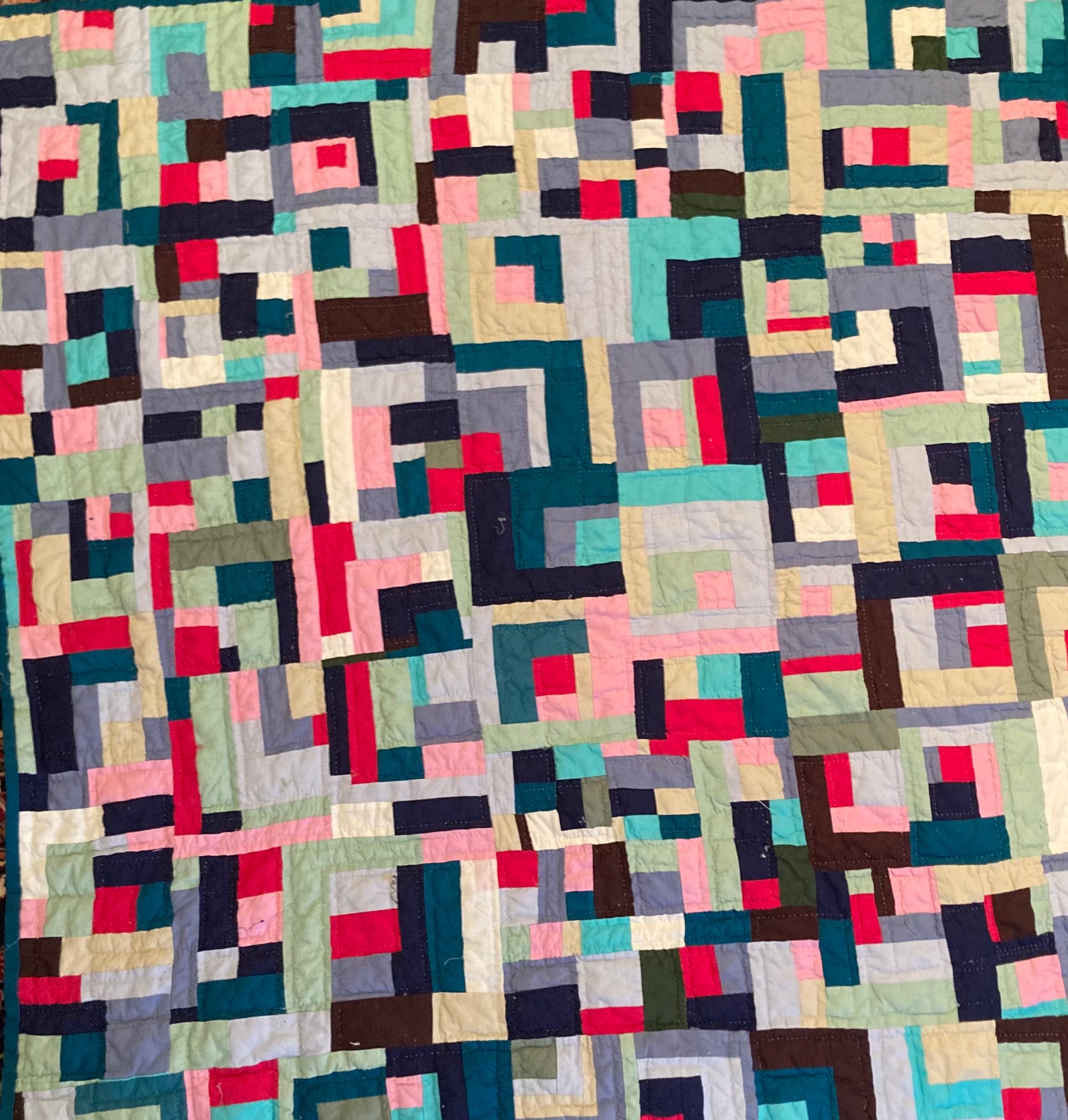
For a number of years, I did not write. But I did quilt throughout. I knew I would definitely return to stories, but felt called to do other things, and I felt both solace and exhilaration in sewing pieces of cloth together and then sandwiching them with soft batting. I hadn’t quit writing, per se. I was just taking a BREAK.
My partner insisted that my quilting WAS writing.
Which, after years, I have come to realize, was true. It is my way of processing things before they become words.
The first cut
Quilting is really two things:
Making the quilt top: piecing, the process of taking different pieces of fabric and sewing them together to make a whole quilt top. This can be done via a sewing machine or by hand. I switch between the two.
Assembling the quilt: quilting, combining the three layers of a quilt (the quilt top, the batting, and the backing fabric) to finish the quilt. There are several ways to sandwich these layers together: tying knots, using a sewing machine, or quilting by hand. My method is to quilt by hand.
For the purposes of this post, let’s focus on piecing.
Piecing entails taking pieces of fabric and figuring out how you want them to come together to make a design. Some folks will work off a pattern. But I rarely do. Even when I see a pattern, I find myself off-roading more often than not. Working without a pattern is categorized as improv.
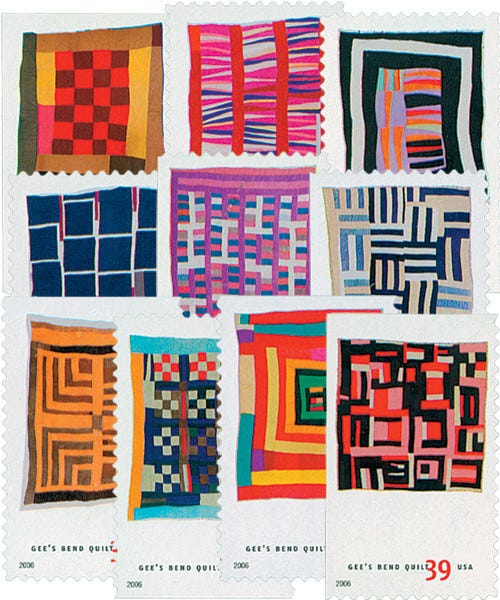
The Gee’s Bend quilts, for instance, are some of the most well-known and well-regarded examples of improv quilting.
Fabric comes to a quilter as whole cloth or in pieces known as “scraps.” Even with fabric scraps, we often have to cut them to the shape we want for our quilt top. Whole cloth definitely gets cut down.
And it is hard, often, to cut into a beautiful piece of cloth. Sometimes the cloth itself is very expensive, hand-dyed, hand-woven, or all of the above. Why would you cut that down? To make a quilt. But also, to be a quilter is to admire fabric, and so it is always a little painful to cut what was whole into pieces.
And yes. A friend of mine once gifted me hand-woven, hand-dyed fabric.
“Oh,” I told her, “this is beautiful.”
“I thought of you,” she told me.
“But—” I said, thinking on it a little more, “how will I cut into this?”
She laughed. “It’s your problem now!”
LOL. That was when I realized she, too, had loved the fabric too much, but understood that the purpose of that fabric was to be used. And she could not do it, so she gave it to me.
But truly, cutting into fabric is tough. I still, for instance, have that piece of fabric.
The same goes for writing, because when we tell our story, whether fiction or nonfiction, we are breaking down something we have been told. We are ripping it down somehow and reconstructing an archetype, a family legend, a preconceived notion, or a traumatic incident. We are re-examining history. We are re-examining beliefs.
Like with the whole piece of cloth, this is part of the writer’s job. We have to break stuff down. And it may very well be the hardest part of storytelling. We may respect the original story or its teller. We may have compassion for why that story was told, even if it was to cover up a truth that was too painful to air. Or we may be furious about a lie, and cutting it up is what we want to do, but how do we cut it up, and how do we dissect it in a way that does the truth justice?
It can be—yes—fraught.
But as a quilter, we cannot think too much about it. We must CUT. DO IT. Our art is dependent on it. That is the fabric’s purpose. That is how the fabric lives on.
(And as I write this, I realize that in my closet is one-hundred-year-old fabric that my maternal grandmother wove by hand as a young woman. Will I ever cut it? See how it never ends).
What we save
Other times, we use pieces of fabric scraps. Leftovers. Smaller and odd-shaped pieces that weren’t used up in other projects. These feel easier to work with because they’ve already been deconstructed. Even if we cut them down further, they feel a little less precious.
And these, too, are the little pieces of our lives that perhaps no one else has understood, or they are the parts that no one else has bothered to examine.
We then look at the pieces and examine them. And see how they resonate. How together, they bring new meaning as a whole. As an improv quilter, I love these scraps. I will often see a pile of scraps and see the pattern of shapes; sometimes the pile itself tells me the story. Are they mostly in strips? Then how many are a similar shape and size? Or can I cut them all down?
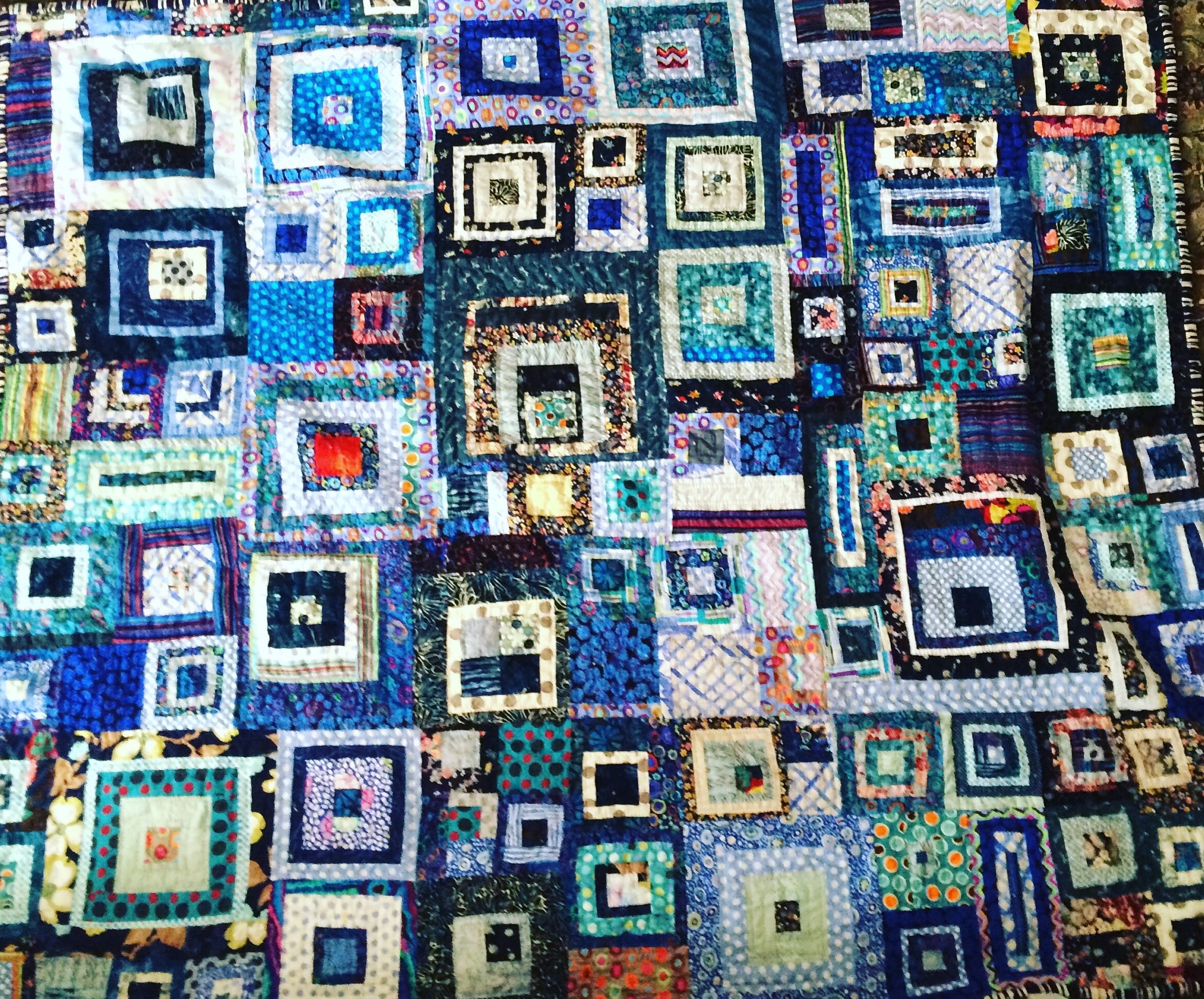
The symbolic side of these scraps does not escape me, either. As a quilter, I am taking odds and ends and pieces and making something new. These odds and ends are literally leftovers, and not big enough to be a main character anymore.
They remind me of so much in the world being cut down these days. Pieces of history are being erased. Laws are being repealed. Civil rights are being taken away. If a particular set of folks had their druthers, America would be living pre-1920s, before anyone but white cis men had the right to vote.
They remind me, too, of quilts being a pillar of historical protest. Quilts served as safe houses along the Underground Railroad, and their patterns communicated specific messages, whether warnings about nearby danger or directions to sanctuary. American women used signature quilts to raise money for the right to vote. Many of us, too, remember the creation of the AIDS Memorial Quilt, which memorialized people who died of AIDS and protested government inaction. Protest quilts continue today; they were very present at 2026’s Quiltcon in Raleigh, protesting ICE and other forms of fascism.
And so, taking little pieces of fabric and giving them a second life, taking little pieces of leftovers and making them part of a meaningful whole, is a FEELING of rejuvenation and recreation. It is for me, a way of saying things are not all lost. Things are not completely ruined; we can rebuild, and we are constantly making something out of nothing. We will preserve what was to be discarded. You know?
Arrangement is meaning
And how does it even come together?
Maybe you’re following a pattern. But even then, you have the choice of color. You have the choice of a deeper hue. Or a lighter value. You have the choice of using patterned fabric or solid. You are putting it together with these myriad variables into something that is uniquely you.
Like a novel or memoir. You are curating. You are seeing what resonates. You may choose one color that repeats. That repetition may be very regular or it may be irregular. But each time it shows up, it shows up differently, or it may be a part of a whole.
You may be using a bunch of different colors that show up as chaos up close, but far away, shows a bigger picture.
These are a combination of the intuitive and the conscious, just as writing can be. Sometimes you have to put it all down, and then take away. Sometimes you put some down, and then add.
Can you believe that these two little exercises are from the SAME sewing methodology?


They share similar color palettes. They are both composed of a bar (one big solid strip) and a bunch of strips. But the one on the left has 3 strips, two of which are the same color as the bar. The one on the right has many strips, none of which match the bar's color. They are remarkably different in outcome.
We can, for example, assign the same assignment to many different writers, and each will come up with their own story.
Here’s an example of different outcomes from one prompt: In the summer of 1816, which was a particularly dark and cold summer due to a volcanic eruption, Percy Bysshe Shelley, Lord Byron, John Polidori, Claire Clairmont, and Mary Wollonesonecraft Godwin gathered near Lake Geneva. Each of them came with a good amount of heartache, escaping some kind of agony. Imagine the EMO.
Because of all the volcanic ash, they spent a great deal of time indoors.
With this as a backdrop, Lord Byron proposed that they each write ghost stories.
And they did.
John Polidori wrote Vampyre, which became the inspiration for Bram Stroker’s Dracula. Lord Byron wrote The Darkness. Mary Wollonestonecraft Godwin wrote Frankenstein.
I’ve also had my fair share of obsessing over hexagons. There is, yes, a connection to honeybee comb in there. But I do love a good hexagon. Here are two different hexagon quilts.


Both quilts use hexagon-shaped fabric pieces. both use the same fabric, really. But they are arranged differently.
On the left, I’ve used the “fussy-cut” fabrics to form flower patterns. On the right, I’ve prioritized the negative space to show white bars on the quilt, such that the patterned colored fabric recedes to the background.
There are so many stories one can tell from the same materials. This is how genre, for instance, is created. Our choices determine the story.
What you choose to notice: A segue
The inevitable segue! Forgive me.
A little note on fussy-cutting: it’s when you cut fabric to highlight its patterns. It is an example of prioritizing fabric pattern. It’s VERY fussy, hence the name.


On the left are the hexagon pieces sewn together to resemble flowers. Can you see which parts of the fabrics on the right are highlighted in the petals of the flowers on the left? The middle fabric (the pink and teal with a pink center) was cut to highlight each of those “circles,” and they are the petals of the center flower.
The pattern on the far right was fussy cut in two different ways. In one cut, I centered the radiating orange “petals” in the hexagons. And they are in the petals of the flower on the upper left of the quilt. And in another cut, I centered the central disk of the flower and those then are the petals in the upper right flower of the quilt.
There are myriad variations.
The stories are ripening
Do you make your story big? Do you make it small? There is value in each format.
I went ham on the “strips and bars” motif. I went big. And I went small.
Even while making this big quilt, I had to layer the rows on top of each other to see it as a whole. And I really LOVED the illusion of those “squished rows,” honestly.
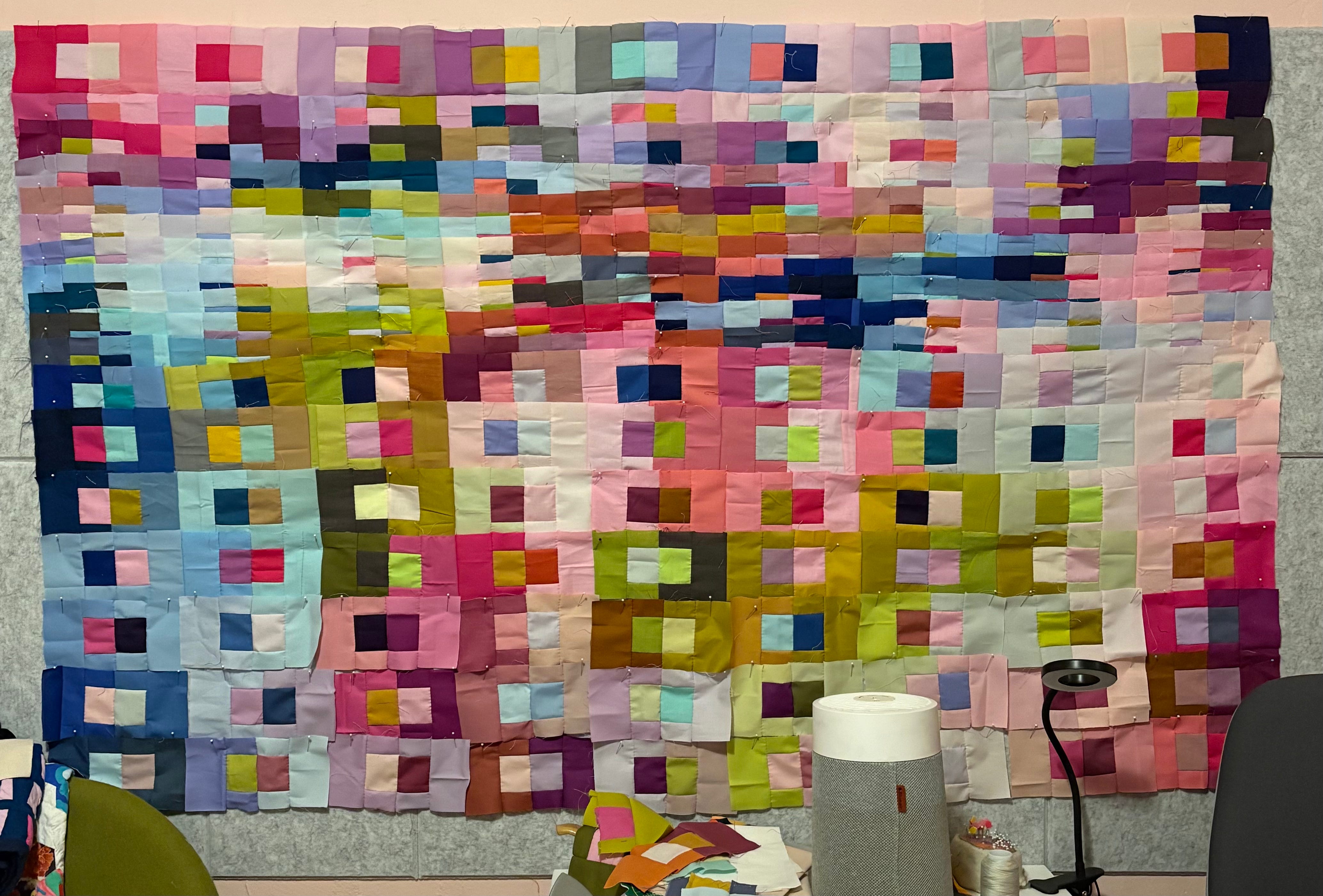
But in the end, I went both big and small with this. They are their own unique story. They are their unique process. They each have their own experience for both the creator and the viewer.


There are different things that I have experienced in making both the small and big formats. And it isn’t unlike when we write and experiment with point of view (1st or 3rd?) or setting or the narrator’s perspective. We have to play in order to experience the fullness of our work.
The finished product is never fully aligned with my original intentions. And in that sense, too, quilting is writing. It is helping me understand the balance between intuition and intention, and between the subconscious and the conscious. That is a muscle, too, exercised in creating something outside of words, which then informs the words.
There are so many things in our lives that help us process them so we can put them into words. And there are many things in our lives that help us develop the creative muscle to make the word-stitching serve the story we want to tell.
Maybe it’s exercise (I wish I were you, believe me). For others, it is creating something tactile. But even when we are not putting words down on the page, we are putting words together. The stories are ripening.
What do you do when you are not writing? How does it connect to your stories?
I swore I wrote down something you said in workshop about cutting into fabric. It was something about "other people's intentions" (the fabric before you cut into it). Whatever it is, it stuck with me.
I find that my non-writing activities don't map neatly onto writing, at least in any obvious way. But my subconscious is always spinning, and keeping my hands busy allows those thoughts to work themselves out. (I know this is an ADHD thing, but I can't remember the name of it. Maybe it pertains to the concept of embodied cognition, too?)
Your quilting is extraordinary! Makes my heart sing!